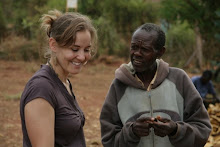
Thanks to my wonderful traveling friend Phil, all the videos that I've taken thus far have been posted on my youtube account (megansings414). Here's one for your enjoyment - there are many others from the Red Rose Christmas party, my house, the University and a few randoms if you visit here.
This video and a future post (promise!) are all thanks to Bev and Sheryl from Expanding Opportunities - who invited me to join on an art tour over the last two weeks to visit the artisans around Kenya that they work with to support their children's home and other projects. We were also joined by Holly Elzinga, whose website Our Fair Earth is definitely worth checking out for wonderful fair trade products (she does wholesale and design work too!). All inspiring ladies who are using their many talents to help women and children explore both their education and creative potential. I also enjoyed getting to know a young woman named Rachel who has just moved over here to live and volunteer with the boys at the Expanding Opportunities children's home. As I got to know her a bit and see her excitement for the work she will do I felt like I was re-living my experience in South Africa and it made me miss Nkandla and the kids there tremendously. She is in for a wonderful, humbling, challenging and life changing experience - these boys are blessed to have her.
I am still struggling to capture in words the reality of daily newspaper headlines about a government-created food shortage, stories of children with nothing but green mangoes to eat, the still-bleeding sore on a small child's knee left by the woman supposed to care for him or the tears Rachel cried (tears I know well) as we left a struggling school and the young boy who had attached himself to her hip during our short visit. It's as if I am in a new stage of observation, awareness, absorption and renewal. There are moments in every day when the reality of the situation around me makes my heart so heavy I want to pack it in and go home. There are just as many, if not more, moments where I come across people like the women I traveled with for the last two weeks, actively opening their hearts to the stories of people in need - even when they can't help...or getting to know my professors, who have lived through colonization and independence and even with the myriad of information that points to failure, corruption, backwards development and the horrendous inequities in the global system that affect this country, come to class every day ready to inspire and challenge us to SEEK A SOLUTION.
I will never get used to coming from plenty when living amongst little. Sometimes the process is heavier than others - and I fear that to delve into it here too much would betray the beauty and blessing of this experience as a whole. At the same time, (and I'm sure I'm repeating myself), I feel called to share the story of this experience and all that it entails, even when it's not pretty. Thank you for giving me the space and encouragement to do this, and hopefully there will be bits of hope that come through in my words, photos and the voices of those around me that I can share by way of videos and stories.
Tuesday, January 27, 2009


Tuesday, January 20, 2009
On the road to craftville...
More on the rest of last weekend in my next post, but here's my favorite picture from Saturday's visit to a group of Masai beaders. They were quite entertained by the video that I took of their dancing.

In other news - just got back from watching the inauguration on the main quad at my campus with about 2,000 of my fellow students. It was joyous! Will upload those pics soon too!

In other news - just got back from watching the inauguration on the main quad at my campus with about 2,000 of my fellow students. It was joyous! Will upload those pics soon too!
Tuesday, January 13, 2009
In lighter news...
Our internet is pretty good but still preventing me from uploading more than a couple photos at a time. So, I'm gonna send all my photos home with Phil to upload for me - and just give you a sneak peak of the wonders of Zanzibar in the meantime. I'm spending a lot of time revisiting it in my head - especially the brief introduction I had to scuba diving where I came up close and personal with a coral reef (and 4 moray eels!). I'm trying to finish a paper on coral reef management right now and I think swimming in them (scuba-induced panic attack and all) was way more fun than writing about the many threats facing their survival here in Kenya.
Enjoy!


Enjoy!


Sunday, January 11, 2009
Need
It's hard to try and share the desperation that I've started to see in the lives of those living on the margins here in Kenya. It drove a good kid with the trust of our house to risk it all for the sake of bringing home something to support his family, it drives one of Megan's part-time Zanna staffers to walk up to six hours a day (oh how I wish this were an exaggeration) to take advantage of a new job opportunity extended by one of my craft contacts here, and it leads to stories like the one I'm about to share. My pockets aren't deep enough to cover all of the daily opportunities I have to take even small amounts and make profound differences in some of the young lives around me, and I know part of my role as a storyteller is to be willing to ask for help when the need is great. I know it's not a convenient time to give - but if you are so moved to join me in providing sustainable support for some of the people that are making my experience here so profoundly insightful, I would be forever grateful.
The following was shared by a Rotarian before a recent speech I gave at the oldest Rotary club in Nairobi. It stands out to me as it came just a week after I received an email from a woman I worked with in Rising International sharing about the loss of her aunt during child birth due to lack of access to a cesarean in her native country. I promised I would share this story in the hopes of raising a bit of support for this family.
From Rotarian Michael Fairhead: "We have worked for many years in rural Kitui and we have people there whom we help to gain a livelihood. That is how we learnt about this case. Once there were 2 childhood sweethearts in Kitui whose love remained intense even as they grew older. They had 3 baby girls, all by caesarean section who were all very well cared for and very intelligent and happy. The parents so wanted a boy that they risked a fourth pregnancy and the advising doctor at Kitui General Hospital agreed to undertake a caesarean section at 8am of the due day. The wife went into the hospital the evening before as arranged, taking her sister. During the night she went into labour and quickly an emergency operation was essential. The doctor refused to turn out until the morning, even though all the surgical facilities were available that night and the sister and the nurses begged him to come. At 4am she started major bleeding and she bled to death in the arms of her sister. The baby boy also died. The poor husband was utterly heartbroken that his beautiful wife and his longed for son had died so tragically and he was unable to cope and sadly took his own life. The 3 girls were left as orphans for the grandmother and family to take care of. Thanks to community the girls were looked after. Two years ago the grandmother became unable to move around and the oldest, Damaris, had to drop out of school at the age of 14 to care for them all. The grandmother has now died and the girls are orphans. They need support for school fees for several years in senior school and we believe they are all capable of going to university. We cannot afford to go on supporting these poor children without other help and sponsorship. It costs at present Kshs.25,000* per child for secondary school. So far only Damaris is in secondary school. We respectfully ask for the help of Rotarians with sponsorship or linking to sponsors and thank you so very much. Below is a statement in Damaris’s own words."
"I am Damaris Mbeleko. I am 16 years old. I was born in Kitui District. Matinyani Division, Mutulu Location, Kavalula Village. I have 2 sisters, Mutindi and Mukai. I am the first born in the family, Mutindi second born and Mukai last born. My dear parents passed away when I was in class two and I couldn’t even believe it. Since that time my poor grandmother started struggling and wondering more about our lives and about our studies. Although she was old she couldn’t do any job to get money so she used to go door to door to our relatives and neighbours asking for some food and some basic needs like clothes, shoes and other things for us to wear and eat and they all very kindly supported us. When I was in class 7 my dear grandmother was now so very old that she couldn’t even walk very far and she couldn’t do some duties at home so I was the only one to take care of my siblings. I used to go to our neighbours after school to ask them for some food for my sisters to eat. This affected my studies because some nights I couldn’t do revision or homework because of no paraffin and the late hours. I explained everything to my teachers and they helped me and advised me a lot. On entering form 8 I just said “First I will look forward towards academics so later on I can help my siblings." By the end of the year I had performed well and was getting worried what to do next. I just thanked God for the chance of passing my final examination. I had been admitted to Mutumo Girls Secondary School but due to lack of School Fees my neighbour decided to take me to St.John’s Kwa-Mulungu Secondary School, where I am still working to achieve my dreams and my goal to be able to help my siblings in the future as well as our community and my Country. My sisters are still in primary school. Mutindi is in class 8 and Mukai in class 6. They are still working very hard at school. In their report books Mutindi was 3rd of 36 pupils and Mukai 10th of 45 pupils. My hope and dream is to find somebody to support us at school so as to fulfill our dreams."
I know what it feels like to have been given the gift of pursuing your dreams. Damaris wants to be a doctor. We need more of those here!
If you would like to contribute to the education of Damaris and her sisters, you can send a donation c/o my address in the US:
1528 Salinas Hwy. D
Monterey, CA 93940
Asante Sana to all.
*25,000 Kenyan shillings is roughly $320 U.S. dollars.
The following was shared by a Rotarian before a recent speech I gave at the oldest Rotary club in Nairobi. It stands out to me as it came just a week after I received an email from a woman I worked with in Rising International sharing about the loss of her aunt during child birth due to lack of access to a cesarean in her native country. I promised I would share this story in the hopes of raising a bit of support for this family.
From Rotarian Michael Fairhead: "We have worked for many years in rural Kitui and we have people there whom we help to gain a livelihood. That is how we learnt about this case. Once there were 2 childhood sweethearts in Kitui whose love remained intense even as they grew older. They had 3 baby girls, all by caesarean section who were all very well cared for and very intelligent and happy. The parents so wanted a boy that they risked a fourth pregnancy and the advising doctor at Kitui General Hospital agreed to undertake a caesarean section at 8am of the due day. The wife went into the hospital the evening before as arranged, taking her sister. During the night she went into labour and quickly an emergency operation was essential. The doctor refused to turn out until the morning, even though all the surgical facilities were available that night and the sister and the nurses begged him to come. At 4am she started major bleeding and she bled to death in the arms of her sister. The baby boy also died. The poor husband was utterly heartbroken that his beautiful wife and his longed for son had died so tragically and he was unable to cope and sadly took his own life. The 3 girls were left as orphans for the grandmother and family to take care of. Thanks to community the girls were looked after. Two years ago the grandmother became unable to move around and the oldest, Damaris, had to drop out of school at the age of 14 to care for them all. The grandmother has now died and the girls are orphans. They need support for school fees for several years in senior school and we believe they are all capable of going to university. We cannot afford to go on supporting these poor children without other help and sponsorship. It costs at present Kshs.25,000* per child for secondary school. So far only Damaris is in secondary school. We respectfully ask for the help of Rotarians with sponsorship or linking to sponsors and thank you so very much. Below is a statement in Damaris’s own words."
"I am Damaris Mbeleko. I am 16 years old. I was born in Kitui District. Matinyani Division, Mutulu Location, Kavalula Village. I have 2 sisters, Mutindi and Mukai. I am the first born in the family, Mutindi second born and Mukai last born. My dear parents passed away when I was in class two and I couldn’t even believe it. Since that time my poor grandmother started struggling and wondering more about our lives and about our studies. Although she was old she couldn’t do any job to get money so she used to go door to door to our relatives and neighbours asking for some food and some basic needs like clothes, shoes and other things for us to wear and eat and they all very kindly supported us. When I was in class 7 my dear grandmother was now so very old that she couldn’t even walk very far and she couldn’t do some duties at home so I was the only one to take care of my siblings. I used to go to our neighbours after school to ask them for some food for my sisters to eat. This affected my studies because some nights I couldn’t do revision or homework because of no paraffin and the late hours. I explained everything to my teachers and they helped me and advised me a lot. On entering form 8 I just said “First I will look forward towards academics so later on I can help my siblings." By the end of the year I had performed well and was getting worried what to do next. I just thanked God for the chance of passing my final examination. I had been admitted to Mutumo Girls Secondary School but due to lack of School Fees my neighbour decided to take me to St.John’s Kwa-Mulungu Secondary School, where I am still working to achieve my dreams and my goal to be able to help my siblings in the future as well as our community and my Country. My sisters are still in primary school. Mutindi is in class 8 and Mukai in class 6. They are still working very hard at school. In their report books Mutindi was 3rd of 36 pupils and Mukai 10th of 45 pupils. My hope and dream is to find somebody to support us at school so as to fulfill our dreams."
I know what it feels like to have been given the gift of pursuing your dreams. Damaris wants to be a doctor. We need more of those here!
If you would like to contribute to the education of Damaris and her sisters, you can send a donation c/o my address in the US:
1528 Salinas Hwy. D
Monterey, CA 93940
Asante Sana to all.
*25,000 Kenyan shillings is roughly $320 U.S. dollars.
Wednesday, January 7, 2009
Coming home
I spent new years eve 2008 watching fireworks from a Zanzibar beach and dancing with a dread-head named Mr. Kifufi. I'd love to show you pictures, but my traveling companion Phil dropped his camera in the ocean the following day attempting to capture the brilliance of a Zanzibar sunset from the warm water of the Indian ocean. I do have lots of other pics from the trip that I will attempt to post this weekend, along with getting caught up on a number of things I intend to share here - including my trip to Nanyuki to visit the weavers and spinners there (which feels like ages ago), Christmas in Kenya and then some general complaints about being bogged down with assignments when it's beautiful and sunny outside and it seems like there are so many things I'd like to do while I'm here other than stare at my computer screen reminding myself that the weight of the world doesn't rest on whether or not I figure out how to keep my sentences a bit more concise and to-the-point in my papers (or blog posts...). I'm actually really enjoying my assignments, it's just amazing how out of practice I feel academically - and the sleeping dogs of procrastination refuse to awake and make themselves scarce so I spend a good amount of time beating myself up for not just taking things a bit more piece by piece.
I realized when I returned from Zanzibar that I've entered a new phase in my time in Kenya. The newness of being here has somewhat worn off and I came home to familiarity and routine. I want to be careful about this and maintain the openness that being in a new place brings - I practically walked around with bells on for the last three months with the wonder of the people I have had the opportunity to meet and interact with, and the many opportunities to learn and grow in regards to the many issues I'm here to address. I also want to make sure I stay present with my goals for my time here - life right now revolves 100% with getting through the end of the semester (exams start second week of February) and while my studies are incredibly important to me, they aren't the sole definition of my time here, so I'm finding I have to give myself a bit of grace as I navigate through.
I'm still catching up on emails and trying to readjust to having the internet at home - sometimes I kind of stare at my computer and wonder how I ever used to spend so much time wandering the internets. Then an hour goes by, the book on my lap remains unread and I realize I've spent the last 60 minutes contemplating just how sturdy one pair of walking sandals on zappos.com might be compared to another on the streets of Nairobi...
Happy new year to all - more from me soon!
I realized when I returned from Zanzibar that I've entered a new phase in my time in Kenya. The newness of being here has somewhat worn off and I came home to familiarity and routine. I want to be careful about this and maintain the openness that being in a new place brings - I practically walked around with bells on for the last three months with the wonder of the people I have had the opportunity to meet and interact with, and the many opportunities to learn and grow in regards to the many issues I'm here to address. I also want to make sure I stay present with my goals for my time here - life right now revolves 100% with getting through the end of the semester (exams start second week of February) and while my studies are incredibly important to me, they aren't the sole definition of my time here, so I'm finding I have to give myself a bit of grace as I navigate through.
I'm still catching up on emails and trying to readjust to having the internet at home - sometimes I kind of stare at my computer and wonder how I ever used to spend so much time wandering the internets. Then an hour goes by, the book on my lap remains unread and I realize I've spent the last 60 minutes contemplating just how sturdy one pair of walking sandals on zappos.com might be compared to another on the streets of Nairobi...
Happy new year to all - more from me soon!
Tuesday, January 6, 2009
Contact Info
Ok - I've got skype up and running so I thought I'd include all my contact info for easy reference!
My phone number is: +254(0)734 715 780 - if you're in Nairobi start with the zero, if you're in the states, leave the zero out.
Website: www.megangoestokenya.blogspot.com
Facebook: Click Here
Skype: meganmacdon / Kenya
Photos on smugmug: Click Here
Email: meganmacdon AT gmail DOT com
Address:
Megan MacDonald c/o Margaret White
PO Box 73405-00200
Nairobi, Kenya
Unfortunately, nothing of "value" should be sent by mail as it can be assessed a random tax amount based on the perceived value according to the customs agent that opens it (ya, it gets opened). My roommate once had to pay tax on a bar of soap. But a friend who studied here last year said small packages (the size of a VHS or smaller) don't tend to cause much upset - and things like burned CDs/DVDs, small food stuff/goodies etc. shouldn't be a problem. Or, anything that looks previously owned/used tends to get by. Fortunately for me - there's nothing more valuable than a hand-written note from home!
My phone number is: +254(0)734 715 780 - if you're in Nairobi start with the zero, if you're in the states, leave the zero out.
Website: www.megangoestokenya.blogspot.com
Facebook: Click Here
Skype: meganmacdon / Kenya
Photos on smugmug: Click Here
Email: meganmacdon AT gmail DOT com
Address:
Megan MacDonald c/o Margaret White
PO Box 73405-00200
Nairobi, Kenya
Unfortunately, nothing of "value" should be sent by mail as it can be assessed a random tax amount based on the perceived value according to the customs agent that opens it (ya, it gets opened). My roommate once had to pay tax on a bar of soap. But a friend who studied here last year said small packages (the size of a VHS or smaller) don't tend to cause much upset - and things like burned CDs/DVDs, small food stuff/goodies etc. shouldn't be a problem. Or, anything that looks previously owned/used tends to get by. Fortunately for me - there's nothing more valuable than a hand-written note from home!
Thursday, December 25, 2008
Selling Eggs to Buy Bread
I’ve wanted to share a bit about the Development field for awhile – but as it currently represents everything I’m studying, it’s hard to know where to start. I can say that in most ways, my perception and understanding of Development is changing everyday, as it is truly a discipline that carries a multitude of dimensions and perspectives. Unfortunately, or fortunately, it’s also an industry here – so on top of the theoretical and historical aspects I’m studying, there is the practicum I see around me. The sad reality is that what in my perspective is a discipline that should be rooted in sustainability and the external focus of aiding nations in need, is often turned into a for-profit machine that employs loads (many foreigners), while directly contributing to some of the challenges facing local people. I met my friend Attem the other night and he was telling me about the high cost of living in Southern Sudan. After quoting some prices, I asked who was supporting that level of living – who could afford to pay those prices and thus enable the market to keep them that high? “Well, there are a lot of NGO’s there,” he said. So, you’ve got a lot of NGO’s on the ground with a variety of goals that we can assume boil down to HELP SUDAN, and their mere presence is making it hard for local people to afford basic needs.
In one of my first classes here, we were introducing ourselves and a classmate said he worked for a NGO that was focused on poverty alleviation. My professor asked, “So you get a job out of it, what do the people you’re helping get?” I come back to this question over and over as I reflect on my reason for being here and my long-term goals. Development work, in so many ways, can never truly be altruistic – the “developer” needs the country in need to advance for a number of reasons. On an international scale, we all benefit if others advance and become producers of goods we want/need, and consumers of goods we have. There do become reasons why certain countries advancement and development become problematic – it is infinitely easier to exploit natural resources from a country with no infrastructure or stable government. It has also become obvious that whatever developed nations’ goals are for aiding the developing world, the theory and political ideology that guides the assistance offered can have horrendous consequences on the natural course of development that might be taking place.
In post-colonial Kenya, the country was doing quite well in the 60’s and early 70’s – at one point 95% of children were enrolled in school, industrialization was in place and the country had a solid export industry and access to international markets for coffee, tea and other products. Following the oil crisis in ’73, progress was stymied and Kenya got swept up with the rest of Sub Saharan Africa in low-interest borrowing when the commodity market fell apart. When the global economy started to recover and the interest rates started to rise, Kenya and other SSA countries shifted their focus from industrialization and programs focused on bringing equity to their populace, to straight debt management. The U.S. and Britain guided the World Bank and IMF in providing public loans to relieve the private sector of this debt burden, but they came with contingencies that ultimately reversed years of growth in Kenya by requiring the government to pull out of the market and social programs completely in favor of Neo Liberal, market-driven economics. Close to thirty years after these structural adjustment programs were implemented, Kenya is just starting to see the same levels of children enrolled in school, carries somewhere between a 50-60% unemployment rate and as we saw last January, has a long way to go in terms of democracy. What started as a developing sprint has turned into a marathon, with what was intended to be a paved road turned to a fragmented cobblestone street with gaping potholes along the way.
My housemate Megan has been in Kenya for eight years and has worked on a variety of poverty alleviation programs. I trust her work more than many of the ex-pats I come across who know very few Kenyans, live in posh compounds and guide their work based on studies rather than interactions or involvement in the community they’re attempting to aid. After working with street children when she first came, Megan has a network of people who come to her for help, and we never know who we might find washing dishes or cleaning floors in our home in exchange for a day’s wage or some food staples. For the last month a young man named Labon has been here once a week or so, and I always appreciate his big smile and hard work. His family lives in Kibera and Megan has acknowledged that his mother and brother are not trustworthy (his brother’s not allowed in the house), but if Labon comes and works she will send him home with food. When she told me this I acknowledged that Labon just seems to have a good heart – and certainly a good work ethic. Then last week I noticed that a favorite necklace of mine that I “borrowed” from my mom last year wasn’t hanging in the downstairs bathroom where it usually is. It’s the only necklace I’ve kept out of my room because I know Megan likes to borrow it. It’s on a gold chain and it’s a large leaf that’s covered in gold plate. When I asked the staff about it, it became clear at some point that Labon had taken it and given it to his brother to sell. While it’s startling to have something taken from inside your own home, it’s more startling when someone who you’d personally assessed to be a good guy takes it. The whole thing got me thinking – here’s a kid who is at our house working because his family cannot afford food – but the glitter of gold overrode the good relationship he has with us in favor of a quick fix and the need for cold hard cash.
This feels like the state of development as a whole – there are entire countries whose populace face food insecurity and lack of basic needs, but their leaders succumb to the draw of wealth and quick fixes offered by exploitative industries or less-than altruistic government assistance. Rather than looking at the security and needs of the nation as a whole, or taking the time to establish policies that ensure all people benefit as growth occurs, Developing nations tend to follow the paths of those of us already industrialized – resulting in a wide gap between the haves and have-nots, and a massive contrast between the luxury car of a big city exec and the blistered feet of a rural farmer. When you think about it, who can blame them? It’s humanity acting as humanity does – so I suppose I come back to, how do we change these trends while we still have the chance? Being in Kenya right now I can see that there are opportunities all around to make choices that will benefit all of Kenya – not just those with the education, resources or connections to advance. I hope I continue to learn, and in someway contribute, to this as a goal.
In one of my first classes here, we were introducing ourselves and a classmate said he worked for a NGO that was focused on poverty alleviation. My professor asked, “So you get a job out of it, what do the people you’re helping get?” I come back to this question over and over as I reflect on my reason for being here and my long-term goals. Development work, in so many ways, can never truly be altruistic – the “developer” needs the country in need to advance for a number of reasons. On an international scale, we all benefit if others advance and become producers of goods we want/need, and consumers of goods we have. There do become reasons why certain countries advancement and development become problematic – it is infinitely easier to exploit natural resources from a country with no infrastructure or stable government. It has also become obvious that whatever developed nations’ goals are for aiding the developing world, the theory and political ideology that guides the assistance offered can have horrendous consequences on the natural course of development that might be taking place.
In post-colonial Kenya, the country was doing quite well in the 60’s and early 70’s – at one point 95% of children were enrolled in school, industrialization was in place and the country had a solid export industry and access to international markets for coffee, tea and other products. Following the oil crisis in ’73, progress was stymied and Kenya got swept up with the rest of Sub Saharan Africa in low-interest borrowing when the commodity market fell apart. When the global economy started to recover and the interest rates started to rise, Kenya and other SSA countries shifted their focus from industrialization and programs focused on bringing equity to their populace, to straight debt management. The U.S. and Britain guided the World Bank and IMF in providing public loans to relieve the private sector of this debt burden, but they came with contingencies that ultimately reversed years of growth in Kenya by requiring the government to pull out of the market and social programs completely in favor of Neo Liberal, market-driven economics. Close to thirty years after these structural adjustment programs were implemented, Kenya is just starting to see the same levels of children enrolled in school, carries somewhere between a 50-60% unemployment rate and as we saw last January, has a long way to go in terms of democracy. What started as a developing sprint has turned into a marathon, with what was intended to be a paved road turned to a fragmented cobblestone street with gaping potholes along the way.
My housemate Megan has been in Kenya for eight years and has worked on a variety of poverty alleviation programs. I trust her work more than many of the ex-pats I come across who know very few Kenyans, live in posh compounds and guide their work based on studies rather than interactions or involvement in the community they’re attempting to aid. After working with street children when she first came, Megan has a network of people who come to her for help, and we never know who we might find washing dishes or cleaning floors in our home in exchange for a day’s wage or some food staples. For the last month a young man named Labon has been here once a week or so, and I always appreciate his big smile and hard work. His family lives in Kibera and Megan has acknowledged that his mother and brother are not trustworthy (his brother’s not allowed in the house), but if Labon comes and works she will send him home with food. When she told me this I acknowledged that Labon just seems to have a good heart – and certainly a good work ethic. Then last week I noticed that a favorite necklace of mine that I “borrowed” from my mom last year wasn’t hanging in the downstairs bathroom where it usually is. It’s the only necklace I’ve kept out of my room because I know Megan likes to borrow it. It’s on a gold chain and it’s a large leaf that’s covered in gold plate. When I asked the staff about it, it became clear at some point that Labon had taken it and given it to his brother to sell. While it’s startling to have something taken from inside your own home, it’s more startling when someone who you’d personally assessed to be a good guy takes it. The whole thing got me thinking – here’s a kid who is at our house working because his family cannot afford food – but the glitter of gold overrode the good relationship he has with us in favor of a quick fix and the need for cold hard cash.
This feels like the state of development as a whole – there are entire countries whose populace face food insecurity and lack of basic needs, but their leaders succumb to the draw of wealth and quick fixes offered by exploitative industries or less-than altruistic government assistance. Rather than looking at the security and needs of the nation as a whole, or taking the time to establish policies that ensure all people benefit as growth occurs, Developing nations tend to follow the paths of those of us already industrialized – resulting in a wide gap between the haves and have-nots, and a massive contrast between the luxury car of a big city exec and the blistered feet of a rural farmer. When you think about it, who can blame them? It’s humanity acting as humanity does – so I suppose I come back to, how do we change these trends while we still have the chance? Being in Kenya right now I can see that there are opportunities all around to make choices that will benefit all of Kenya – not just those with the education, resources or connections to advance. I hope I continue to learn, and in someway contribute, to this as a goal.
Subscribe to:
Posts (Atom)